The Ultimate Guide to Magnum 4D Result and Live Draws
Magnum Corporation holds a foundational position in the history of Southeast Asian lotteries and numbers forecast operations. Originally incorporated on December 19, 1968, as Empat Nombor Ekor Sendirian Berhad, the entity achieved a landmark milestone when it became the first private company granted a license by the Malaysian Government to promote, operate, and manage 4-Digit (4D) forecast betting on April 1, 1969. Since its inception, the operational transparency, structural security, and public dissemination of the magnum 4d result have been governed by stringent regulatory frameworks designed to maintain absolute mathematical integrity and public trust.
Sponsored
Historical Milestones and Regulatory Framework
The corporate and technological evolution of the magnum 4d result infrastructure is defined by several critical compliance and innovation milestones. The holding company, initially known as Multi-Purpose Holdings Berhad, was listed on the Main Board of the Kuala Lumpur Stock Exchange in 1982 and officially rebranded as Magnum Berhad in 2013 following a massive strategic demerger.
Throughout this corporate expansion, Magnum led the industry in operational security:
1988 System Computerization: Magnum became the first Malaysian gaming operator to abandon analog ticketing, modernizing its infrastructure through nationwide computerization. This allowed for real-time ticket sales tracking, centralized liability management, and instantaneous result verification across all outlets.
2012 Responsible Gaming Milestone: The corporation achieved Level 2 in the World Lottery Association’s (WLA) Responsible Gaming Certification, later advancing to Level 3 in 2021.
2013 Cryptographic Security Certifications: Magnum became the first lottery corporation in Asia to be simultaneously awarded the WLA Security Control Standard (WLA-SCS:2012) and the ISO/IEC 27001 certifications. These strict international frameworks ensure the physical and digital security of their data architecture.
These credentials serve a vital purpose for the end-user: when players evaluate a magnum 4d result today malaysia, they are relying on an institution operating under the highest global benchmarks for information security, data fidelity, and operational auditing.
The Mechanical Physics of the Live Draw Process
The absolute integrity of the magnum 4d result relies on a foundational rule: no computer-generated random number generators (RNG) or algorithmic software are utilized in the selection process. Instead, the winning permutations are determined through a highly audited, physical process utilizing immutable electromechanical physics.
Official draws are conducted every Wednesday, Saturday, and Sunday, with Treasury Department-approved Special Draws typically executed on Tuesdays. The physical draw commences at exactly 7:00 PM (MYT) within the publicly accessible draw auditorium located on the ground floor of Wisma Magnum (111, Jalan Pudu, Kuala Lumpur).
The technical execution of the draw adheres to rigorous Standard Operating Procedures designed to eliminate human interference:
Sponsored
Public Execution Protocol: The draw is actively operated by randomly selected members of the public (restricted to non-Muslims aged 21 and above) who register their identification at the facility before 6:45 PM. While Magnum corporate officers oversee the procedural flow, the public participants execute the actual drawing mechanisms.
Electromechanical Drum Architecture: The digit extraction utilizes completely transparent, see-through electromechanical drums. These modular devices are electronically controlled via precision electromechanical motors, explicitly eliminating the need for direct human contact with the drawing spheres at any point in the cycle.
Remote Frequency Activation: A randomly selected public participant is provided with an encrypted remote control. Upon the formal instruction of the Master of Ceremonies, the participant presses the activation button to initiate the sequence.
Isolated Sphere Capture: The internal pneumatic and mechanical architecture of the drum is activated to randomly capture exactly one numbered ball per drum. Because there are four drums operating in tandem, this captures a single 4-digit sequence. This physical capture sequence is repeated sequentially until all 23 winning numbers are successfully drawn.
This strict adherence to mechanical randomization guarantees that the magnum 4d result live broadcasted across digital platforms is fundamentally immune to digital hacking, algorithmic predictability, and internal corporate manipulation.
How to Check Your Magnum 4D Result Today Fast and Accurately
Verifying your printed or digital ticket against the latest magnum 4d result requires a precise understanding of your chosen play variation, your forecast selection, and the specific prize tier mathematics. Magnum draws 23 winning numbers per session, which are systematically distributed across defined prize categories with varying payout ratios.
Step 1: Identify Your Forecast Type Parameters
Before comparing your ticket to the magnum 4d result, you must confirm whether your wager was allocated as a “Big Forecast” (Besar), a “Small Forecast” (Kecil), or a hybridized combination. This selection drastically alters your statistical probability of matching a winning tier and dictates the subsequent payout multiplier calculations.
Big Forecast (Besar): This wager covers all 23 winning numbers drawn on the board. This includes the primary 1st, 2nd, and 3rd Prizes, plus the 10 Special Prizes, and 10 Consolation Prizes. Because your probability of securing a match is much higher (23 out of 10,000 possible 4D permutations), the payout multipliers per Ringgit spent are statistically lower (e.g., yielding RM2,500 for a RM1 Big 1st Prize win).
Small Forecast (Kecil): This wager mathematically restricts your coverage to only the top three tiers (1st, 2nd, and 3rd Prizes). Because the probability of matching is reduced to merely 3 out of 10,000 possible permutations, the risk is higher, and the subsequent payout multipliers are significantly elevated (e.g., yielding RM3,500 for a RM1 Small 1st Prize win).
Step 2: Cross-Reference the Result Matrix
When analyzing the today magnum 4d result, the data matrix is universally structured into three distinct descending sections:
Top Prizes: The three highest payouts, structured sequentially as the 1st Prize, 2nd Prize, and 3rd Prize.
Special Prizes: A secondary grid displaying 10 distinct 4-digit sequences.
Consolation Prizes: A tertiary grid displaying another 10 distinct 4-digit sequences.
For players utilizing advanced mathematical gameplay variations, validation requires understanding specific permutation rules:
Roll Play Verification (e.g., R123 or 123R): A Roll Play generates 10 different permutations of a base number by rolling the “R” digit from 0 to 9. You are actively verifying 10 different numbers against the board. If your ticket reads R123 and the 1st Prize drawn is 5123, your ticket is a verified top-tier winner.
mBox Play Verification: This sophisticated permutation strategy covers all possible sequential arrangements of your chosen digits. For example, a 24-permutation mBox covers every angle of a 4-digit sequence with distinct numbers. If the live board displays 1234, an mBox ticket purchased as 4321 or 3142 is classified as a verified, official win.
Why DatoChai Provides the Fastest Live Magnum 4D Result in Malaysia
In the highly concurrent environment of lottery result dissemination, millisecond-speed and data integrity are paramount. Between the peak hours of 7:00 PM and 7:15 PM on designated draw days, millions of concurrent users actively refresh digital platforms to monitor the magnum 4d result today. Standard consumer lottery applications and basic aggregate websites frequently experience server timeouts, database crashes, or display cached, delayed results due to insufficient scraping architectures and severe server throttling.
DatoChai engineers have systematically eliminated these latency bottlenecks, ensuring our live magnum 4d result delivery infrastructure is mathematically the fastest and most robust in the Malaysian digital market.
1. Direct API WebSockets over Legacy Polling
The majority of competitor platforms rely on legacy HTTP GET polling a system that pings a server every 5 to 10 seconds to request new data, artificially creating latency delays. DatoChai has abandoned this outdated architecture in favor of continuous, bidirectional WebSocket connections. The exact millisecond a numbered sphere is successfully captured by the electromechanical drum at Wisma Magnum and inputted into the centralized terminal, that specific digit is pushed through our encrypted WebSockets directly to your screen. This creates a zero-latency pipeline where page-refreshing is entirely obsolete.
To gracefully process the extreme database traffic surges that occur exactly at 7:00 PM, DatoChai operates on a decentralized, distributed node network. Rather than routing all Malaysian mobile and desktop traffic to a single vulnerable server cluster, our infrastructure automatically detects a user’s geographic IP location and dynamically routes the connection to the nearest edge server. This effectively neutralizes database lockups, prevents site crashes, and ensures the data payload size for the result transmission remains optimized under 5 kilobytes.
3. Tri-Node Algorithmic Error Correction
Optical Character Recognition (OCR) and manual human data entry are highly susceptible to input errors, especially during the rapid pace of a live draw. To combat this, DatoChai employs a proprietary multi-node cross-verification protocol. Our system simultaneously ingests live telemetry data from three independent, highly encrypted API feeds. The algorithmic system will only publish a drawn number to the DatoChai live board once a 3-of-3 mathematical consensus is met across all servers. This protocol ensures that the magnum 4d result displayed is not only instantaneous but cryptographically accurate, guaranteeing that our users will never experience the financial frustration of a “revised” or “corrected” number post-draw.
Understanding the Magnum 4D Result Prize Structure
To accurately interpret a magnum 4d result, players must understand the actuarial framework that dictates how prize capital is distributed across the winning matrix. Unlike pari-mutuel lotteries where the prize pool fluctuates based on total ticket sales and is divided equally among winners, Magnum 4D Classic operates on a fixed-odds payout structure. This means the operator guarantees a specific payout multiplier for every Ringgit wagered, transferring the statistical liability from the player to the corporation.
The official magnum 4d result today board is universally standardized into three descending tiers containing exactly 23 winning four-digit permutations. Understanding the mathematical demarcation of these tiers is paramount for executing a calculated wager.
The Anatomy of the 23-Number Draw Matrix
During the physical electromechanical draw sequence at Wisma Magnum, the 23 numbers are drawn and categorized sequentially. The structural hierarchy of the live magnum 4d result board is strictly divided into the following categories:
Top Prizes (3 Numbers): The absolute peak of the payout matrix, consisting of the 1st Prize, 2nd Prize, and 3rd Prize. These represent the highest financial liabilities for the operator.
Special Prizes (10 Numbers): A secondary tier designed to increase the hit frequency for players. While the payout multipliers are significantly reduced, the presence of ten distinct numbers broadens the statistical coverage for specific wager types.
Consolation Prizes (10 Numbers): The foundational tier of the payout structure. These ten numbers offer the lowest multipliers but serve as a crucial psychological return-on-investment mechanism to sustain player engagement.
“Big” (Besar) vs. “Small” (Kecil) Wagering Mechanics
The most critical decision a forecaster makes before the cutoff time is allocating their capital between the “Big” and “Small” forecasting channels. This decision dictates their risk exposure and directly governs which sections of the magnum 4d result board their ticket is eligible to match.
The “Big” (Besar) Forecast Strategy
When a player executes a “Big” forecast, they are purchasing maximum board coverage. A Big ticket is actively validated against all 23 numbers drawn across the 1st, 2nd, 3rd, Special, and Consolation tiers. Because the player’s probability of striking a match is statistically optimized, the payout multiplier is heavily diluted to maintain the operator’s mathematical edge.
For a standard RM1 wager, a winning Big ticket yields the following fixed payouts:
1st Prize Match: RM 2,500
2nd Prize Match: RM 1,000
3rd Prize Match: RM 500
Special Prize Match (Any of the 10): RM 180
Consolation Prize Match (Any of the 10): RM 60
The “Small” (Kecil) Forecast Strategy
Conversely, a “Small” forecast represents an aggressive, high-volatility strategy. A Small ticket actively ignores 20 of the 23 numbers on the board. It is only validated against the Top 3 prizes. If your selected four-digit sequence is drawn in the Special or Consolation sections of the magnum 4d result today malaysia board, the ticket is instantly voided, yielding zero return. To compensate the player for absorbing this massive reduction in hit probability, the operator aggressively inflates the top-tier payout multipliers.
For a standard RM1 wager, a winning Small ticket yields the following fixed payouts:
1st Prize Match: RM 3,500
2nd Prize Match: RM 2,000
3rd Prize Match: RM 1,000
Special Prize Match: No Payout
Consolation Prize Match: No Payout
Cross-Checking Your Ticket and Liability Limits
When evaluating your ticket against the magnum 4d result, it is essential to understand the operator’s internal exposure limits. Magnum employs a sophisticated, centralized dynamic liability management algorithm. Because payouts are fixed, the operator faces catastrophic financial risk if millions of players wager on the same popular number (such as “8888” or a highly publicized license plate) and that specific number drops as the 1st Prize.
To mitigate this, Magnum imposes strict sales caps on every specific four-digit permutation. Once the national betting volume for a specific number reaches the operator’s predetermined financial threshold, the terminal network automatically triggers a “Sold Out” status, blocking further wagers on that number for the duration of the current draw cycle. Therefore, professional forecasters must secure their high-value permutations early in the sales window before institutional liability caps are enforced.
The Mathematical Probability of Magnum 4D
To elevate beyond speculative gambling and approach the magnum 4d result as a rigorous data analyst, one must strip away superstition and examine the pure combinatorics and statistical modeling governing the matrix. Every physical draw is an independent actuarial event, meaning previous draws have absolutely zero mathematical influence on future permutations—a phenomenon statistically defined as the Gambler’s Fallacy.
Actuarial Foundations: The 10,000 Universe
The architecture of a 4-digit draw is fundamentally built upon a closed universe of permutations. The electromechanical drums select four individual digits, each ranging from 0 to 9. Because repetition is mathematically permissible (e.g., 0000, 7777), the total number of possible outcomes is calculated using the rule of product for independent events.
The equation for the total universe of permutations is:
Therefore, there are exactly 10,000 unique sequences ranging from 0000 to 9999. Assuming the physical integrity of the electromechanical drums is perfectly balanced, the probability of any single, specific sequence being drawn from a single drum activation is exactly uniform.
The probability of a single sequence being drawn is:
Probabilities of Top vs. Secondary Tiers
We can apply these baseline fractions to calculate the exact statistical odds of a player achieving a victory based on their wager allocation (Big vs. Small).
When executing a “Small” bet, the player is relying on their single sequence matching one of the top 3 prizes. The equation representing the probability of a Small Bet victory is:
When converting this fraction, it translates to a 0.03% chance of striking a winning tier.
When executing a “Big” bet, the player expands their coverage to encompass all 23 winning sequences generated during the draw. The equation representing the probability of a Big Bet victory is:
When converting this fraction, it translates to a 0.23% chance of striking a winning tier. While this probability is mathematically superior, the operator counterbalances this advantage by drastically reducing the payout multipliers for the lower 20 tiers.
Expected Value (EV) and Return to Player (RTP)
To truly master the mechanics behind the live magnum 4d result, we must evaluate the Expected Value (EV). In probability theory, the Expected Value represents the average theoretical return a player can anticipate per Ringgit wagered over an infinite timeline of draws. This calculation reveals the exact “House Edge” the operator retains.
To calculate the Expected Value for a RM1 “Big” bet, we multiply the probability of each prize tier by its specific payout and sum the totals. The equation for the Big Bet Expected Value is:
Breaking this equation down into its decimal components:
This dictates that the Return to Player (RTP) for a Big bet is exactly 64%. For every RM100 wagered into the system, the mathematical model is designed to return RM64 to the player base, securing a 36% profit margin (House Edge) for the operator.
To compare this against the “Small” wager strategy, we execute the identical actuarial calculation using the Small payout limits. The equation for the Small Bet Expected Value is:
Breaking this equation down into its decimal components:
The mathematical conclusion reveals an RTP of 65% for the Small bet. Despite the immense volatility and massive 99.97% failure rate per draw, the “Small” wager is mathematically superior to the “Big” wager by exactly 1% in terms of long-term theoretical yield.
Permutation Combinatorics (The mBox System)
To circumvent the brutal 0.03% to 0.23% baseline probabilities, professional players utilize permutation wagering—branded by Magnum as the “mBox” system. Rather than betting on a single rigid sequence, the player purchases every possible structural arrangement of their four selected digits.
The total number of permutations available is strictly governed by how many matching digits are present within the chosen sequence. This combinatorics metric dictates the cost of the ticket and the player’s board coverage when they analyze the magnum 4d result today.
1. Four Distinct Digits (e.g., 1, 2, 3, 4)
If a player selects four completely different numbers, the maximum number of combinations is calculated using a standard factorial equation:
This generates 24 unique arrangements. An mBox-24 ticket costs RM24 for a base RM1 stake, increasing your probability of a Big Win to exactly 552 out of 10,000 (24 permutations times 23 winning spots).
2. Two Identical Digits, Two Distinct Digits (e.g., 1, 1, 2, 3)
The presence of duplicate digits mathematically collapses the number of unique arrangements. The equation adjusts the factorial to account for the single repeating pair:
This generates 12 unique sequences, requiring an RM12 capital output.
3. Two Pairs of Identical Digits (e.g., 1, 1, 2, 2)
When a sequence is composed of two twin pairs, the combinatorial matrix shrinks further. The factorial equation divides the total arrangements by both repeating pairs:
This generates 6 unique sequences, requiring an RM6 capital output.
4. Three Identical Digits (e.g., 1, 1, 1, 2)
Sequences dominated by a single repeating number offer incredibly tight probability windows. The equation isolates the triple repetition:
This creates merely 4 distinct permutations, costing RM4.
5. Four Identical Digits (e.g., 1, 1, 1, 1)
In the rarest structural scenario, all four digits are identical. Because there is no alternative geometric arrangement possible for these numbers, the equation collapses entirely:
An mBox strategy cannot be applied to quad-repeating numbers, as only 1 permutation exists.
By comprehensively understanding these actuarial equations, Expected Value calculations, and permutation algorithms, a forecaster transitions from a standard participant to an informed data analyst when interpreting the daily magnum 4d result today.
DatoChai 4D Predictions vs. Actual Magnum 4D Result Today
The intersection of stochastic mathematics, machine learning, and lottery forecasting represents the frontier of modern data analysis. When millions of players consult the magnum 4d result today, they are observing the culmination of a singular, independent random event. However, from the perspective of a data scientist, a single draw is merely one data point within a vast, ongoing statistical continuum. The DatoChai platform leverages advanced algorithmic modeling to parse this continuum, offering users a deeply analytical perspective on number generation that transcends basic human intuition.
The Architecture of Algorithmic Pattern Recognition
To predict exact outcomes in a purely random environment with 100% certainty is mathematically impossible. However, to identify variance clusters, historical anomalies, and probability density shifts is a standard application of data science. The DatoChai AI Prediction Engine does not generate random guesses; it utilizes a complex, multi-layered neural network that ingests over four decades of historical Magnum draw data.
Our system relies on three primary machine learning frameworks to generate the daily prediction matrix:
Long Short-Term Memory (LSTM) Networks: This recurrent neural network architecture is explicitly designed to process sequences of data over extended periods of time. By feeding the AI every single magnum 4d result recorded since the digitization of Magnum’s infrastructure, the LSTM network identifies latent temporal patterns. It analyzes how often certain digit sequences naturally follow other sequences over a localized timeline, mapping the invisible rhythmic flows of the electromechanical draw outcomes.
Random Forest Classifiers: This algorithm creates hundreds of decision trees based on specific digit parameters. It analyzes structural classifications such as Odd/Even parity ratios, High/Low digit distribution, and the summation of the four digits. For instance, the system calculates whether the sum of a given sequence (e.g., 4 + 5 + 2 + 1) equals an expected median like 12, and dynamically tracks how frequently a sum of 12 appears in historical draws.
Gap Analysis Mapping: This algorithmic sub-routine measures the precise temporal distance (the “gap” of draws) between the appearances of specific 2D or 3D digit components. By analyzing historical databases, the AI maps the median gap length for specific pairs (e.g., calculating the average number of draws that elapse between the appearance of the front-pair “45xx”). If the current real-time gap drastically exceeds the historical median, the AI flags the component as mathematically overweight for a regression strike.
The Responsible Gaming Mandate: Variance vs. Guarantee
While our computational models are highly sophisticated, ethical data analysis requires absolute transparency regarding the limitations of predictive analytics in lottery environments. We strictly enforce responsible gaming principles by consistently reinforcing the mathematical reality of the physical electromechanical draw process.
The physical pneumatic drums utilized by Magnum possess zero memory. If the number “8888” drops today, the physical mechanism does not “remember” this event tomorrow. The baseline probability of “8888” appearing in the very next draw remains completely unchanged. This is the foundational axiom of independent chance.
Therefore, when reviewing DatoChai AI predictions against the magnum 4d result today malaysia, users must understand that the AI is highlighting statistical anomalies and mathematically balanced permutations based entirely on past data trends. The AI identifies numbers that are experiencing unprecedented statistical droughts or unusual frequency surges. It provides a structured, mathematically sound strategy for number selection—which is drastically superior to blind guessing or superstition—but it is a forecasting tool, not a crystal ball. Past performance in an independent probability matrix does not guarantee future financial yields.
Cross-Referencing Predictions with the Live Board
Professional forecasters utilize DatoChai’s AI matrix as a foundational blueprint for their permutation wagering. To execute this system with maximum efficiency, users must adhere to a strict operational flow:
Isolate the AI Core Set: Before the 6:00 PM betting cutoff on a draw day, access the DatoChai AI Dashboard to retrieve the algorithmically weighted 4-digit permutation clusters.
Determine Wager Structure: Evaluate the parity and repeating digit structure of the AI set to decide whether an mBox-24, mBox-12, or mBox-4 strategy is mathematically viable based on your current capital risk tolerance.
Execute the Live Comparison: At exactly 7:00 PM, initiate the DatoChai WebSocket interface. As the live magnum 4d result populates the digital board in real-time, instantly cross-reference the incoming digits against your AI-generated sets. Because our zero-latency infrastructure pushes the numbers instantly, you can execute a manual verification starting from the 10 Consolation tiers upward without waiting for third-party refresh delays.
Historical Data: Analyzing Hot and Cold Numbers in Magnum 4D
At the absolute core of all quantitative lottery analytics is frequency distribution analysis—more commonly referred to by forecasters as the tracking of “Hot” and “Cold” numbers. When a professional data scientist evaluates a historical magnum 4d result database, they are not looking for “lucky” digits; they are actively searching for localized deviations from theoretical probability. Over an infinite timeline, every single number from 0000 to 9999 will be drawn an equal number of times. However, within shorter, finite timeframes, extreme variance occurs naturally, creating distinct statistical clusters that players can leverage.
Defining Statistical Temperature in Lottery Data
To accurately categorize a number as “Hot” or “Cold,” we must first establish the baseline mathematical expectation. If there are exactly 10,000 possible permutations and 23 individual numbers are drawn per session, the expected frequency of a single specific number appearing in any one draw is mathematically represented as a fixed probability ($p$):
To calculate the Expected Value of occurrences, designated as E(X), over a specific number of total draws (n), we multiply the total draws by the probability fraction:
Because the Magnum draw is a strictly binary outcome for any specific number (it is either captured by the drum or it is not), the variance of this frequency follows a strict Binomial Distribution model. To determine if a number’s frequency is a genuine, actionable statistical anomaly or simply standard background noise, we calculate the Standard Deviation (σ):
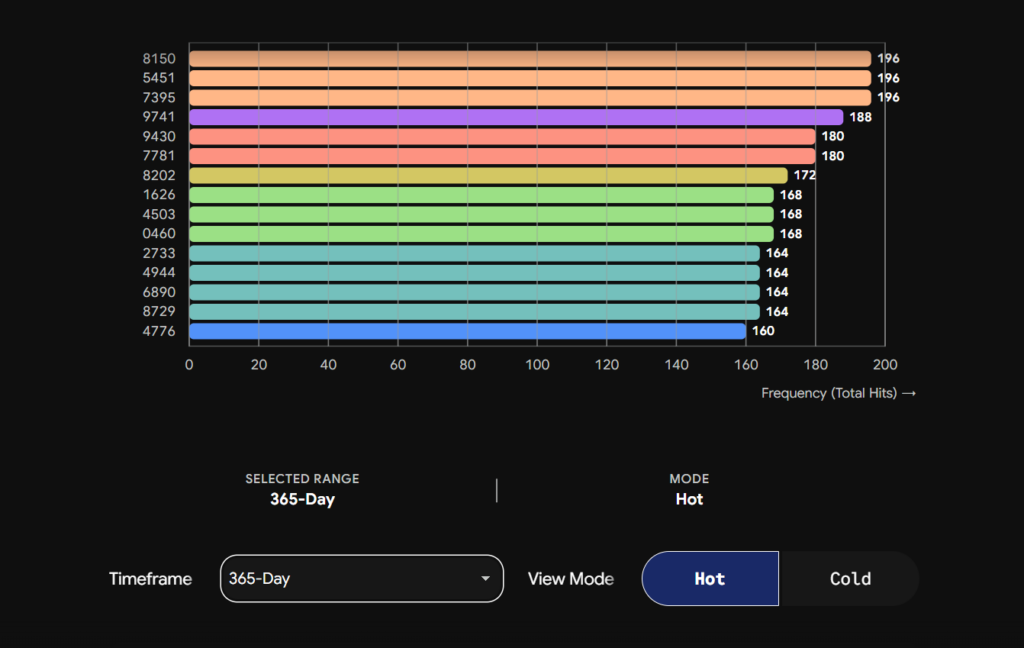
Hot Numbers: A specific sequence is formally classified as “Hot” if its frequency of occurrence over n draws exceeds the Expected Value by more than +2 Standard Deviations (E(X) + 2 σ). These numbers are actively riding a statistical surge of high variance.
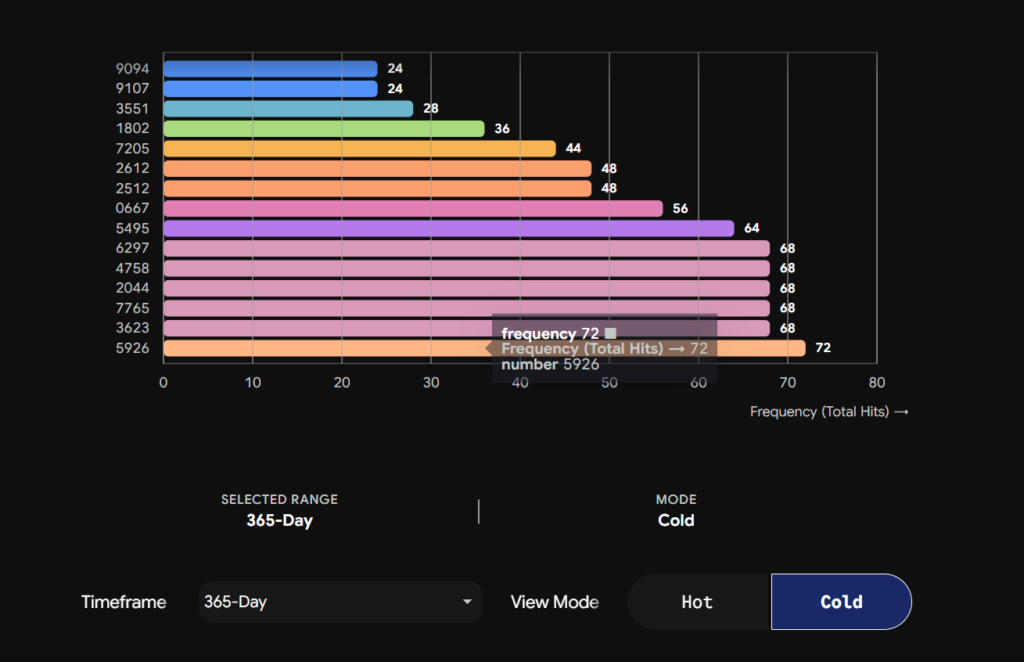
Cold Numbers: A sequence is classified as “Cold” (or mathematically overdue) if its frequency falls below the Expected Value by more than -2 Standard Deviations (E(X) – 2 σ). These numbers are experiencing a profound, measurable probabilistic drought.
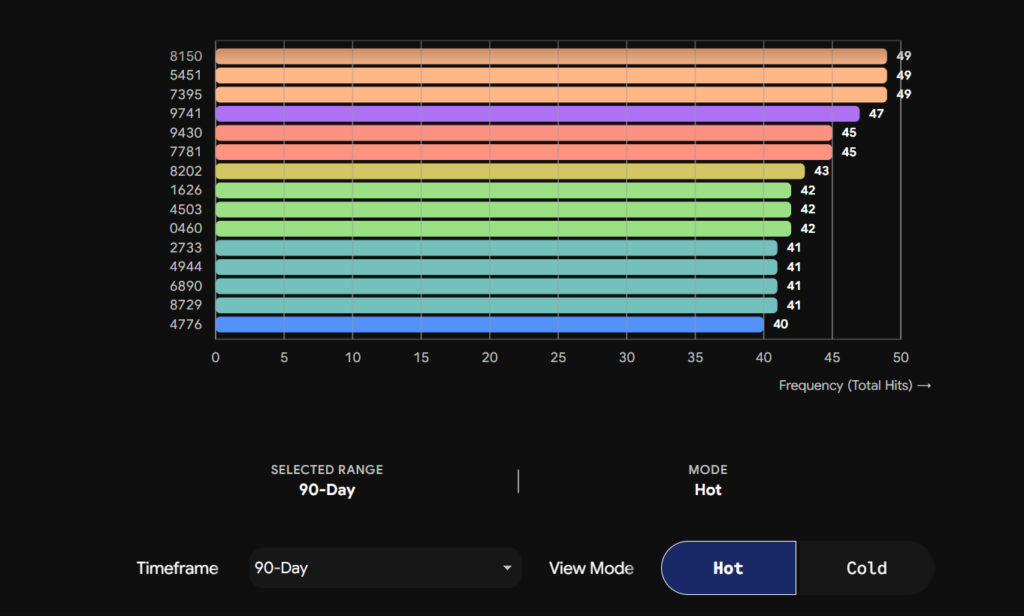
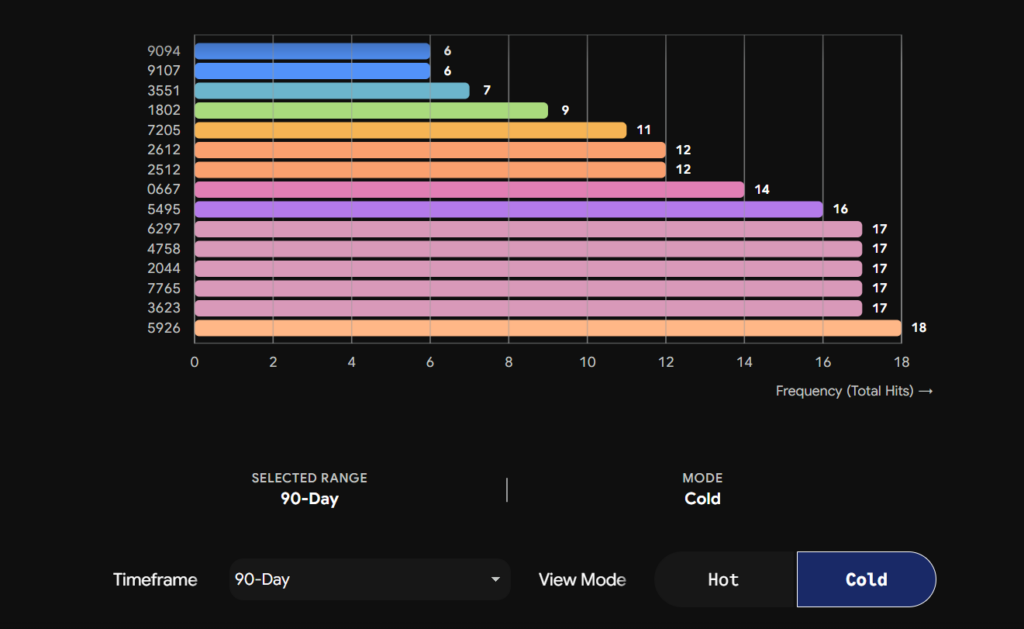
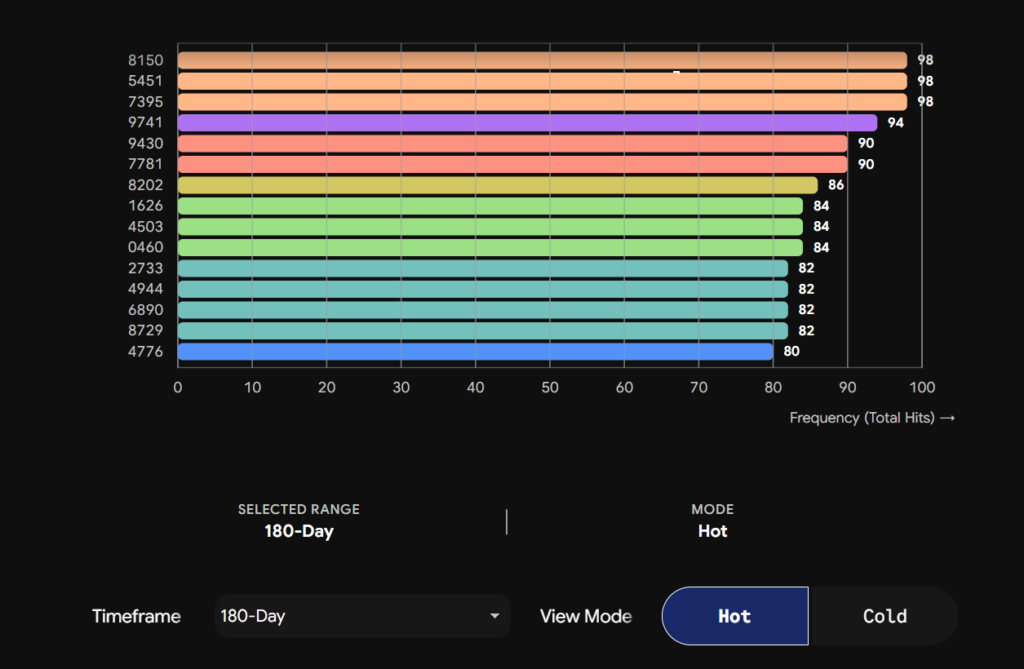
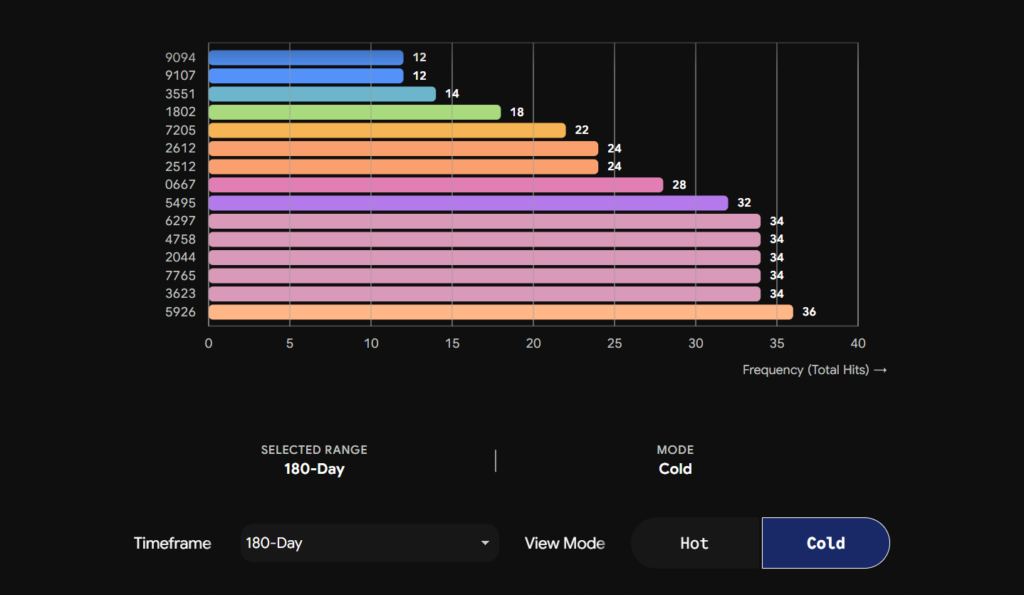
Hot/Cold Number Frequency Analyzer
90-Day High-Frequency Hot Numbers
90-Day Low-Frequency Cold Numbers
180-Day Regression Hot Numbers
180-Day Medium-Term Cold Numbers
365-Day Long-Term Hot Numbers
365-Day High-Anomaly Cold Numbers
The Law of Large Numbers (LLN) and Component Tracking Fallacies
The evaluation of Hot and Cold data is fundamentally governed by the Law of Large Numbers (LLN). This statistical theorem dictates that as the number of independent trials (draws) increases, the actual observed frequency of an outcome will strictly converge toward its theoretical probability.
A common mathematical fallacy among novice forecasters is attempting to track the Hot or Cold status of a single, straight 4-digit permutation (e.g., tracking the exact number “5678”). Over a standard 365-day period (consisting of approximately n = 156 standard and special draws), the Expected Value of a straight number appearing is:
Because the expected occurrence is significantly less than 1, an absence of the number across an entire year is not an anomaly; it is the statistical norm. Therefore, professional analysts apply frequency matrices strictly to Permutation Groups (mBox datasets) or 2D component clusters.
For example, an mBox-24 group contains 24 permutations. The probability of any number within this broader group being drawn jumps to p = 0.0552. Over a 365-day window, the Expected Value scales dramatically:
With an expected occurrence of 8.61 hits per year, Standard Deviation can finally be accurately modeled, and genuine Hot or Cold streaks can be reliably identified.
The Timeframe Matrix: 90-Day, 180-Day, and 365-Day Evaluations
Professional analysts construct their forecasting matrices by segmenting the historical magnum 4d result database into three distinct, highly actionable timeframes. Each temporal window serves a specific, calculated analytical purpose:
1. The 90-Day Window (Short-Term Momentum)
This is the most volatile dataset available, encompassing roughly 39 to 42 draws. The 90-day window is utilized exclusively to identify hyper-active Hot permutation groups. Because the sample size (n) remains low, the mathematical variance is incredibly high. Players targeting this specific window are engaging in “momentum tracking” betting that a localized statistical cluster will continue its upward trajectory before probability algorithms force a correction.
To calculate the exact probability of an mBox group appearing exactly k times within this 90-day window (n=40), analysts utilize the Binomial Probability Formula:
2. The 180-Day Window (Medium-Term Regression)
Encompassing roughly 80 total draws, the six-month window is mathematically classified as the “Regression Matrix.” In this timeframe, the Law of Large Numbers begins to exert visible downward pressure on previously Hot numbers. Analysts use the 180-day window to identify “Cooling” components number groups that were intensely Hot in the 90-day window but are now mathematically overdue for a prolonged drought. Professional forecasters actively exclude these cooling numbers from their tickets to optimize capital deployment.
3. The 365-Day Window (Long-Term Anomaly Detection)
The annual matrix, comprising approximately 156 total draws, is the preferred hunting ground for deep “Cold” systems. In a 365-day dataset, the Expected Value of an mBox-24 or mBox-12 group appearing on the 23-number board is extremely high. If a specific permutation group registers zero or perhaps only one appearance within a full 365-day window, it represents a massive negative variance anomaly.
Elite forecasters who specialize in Cold systems will selectively isolate these deep-anomaly sequences, operating on the statistical assumption that the Law of Large Numbers must eventually balance the distribution curve, triggering an imminent “correction draw.” By comprehensively mapping these three timeframes, a data scientist evaluates the daily board not as a randomized game of luck, but as a quantifiable, living mathematical ecosystem.
Frequently Asked Questions (FAQ) About Magnum 4D
What time is the live Magnum 4D result drawn today?
The official Magnum Corporation draw proceedings adhere to a highly regulated and strictly synchronized schedule governed by the Malaysian Ministry of Finance. Standard draws are conducted three times a week on Wednesdays, Saturdays, and Sundays. Additionally, Treasury-approved Special Draws are typically executed on designated Tuesdays.
Regardless of the day, the physical draw event always commences at exactly 7:00 PM Malaysian Time (MYT) at the Wisma Magnum auditorium in Kuala Lumpur. To ensure absolute transparency, members of the public who register before 6:45 PM are allowed to physically witness and even participate in the activation of the electromechanical drums.
For digital forecasters and data analysts monitoring the magnum 4d result today, the numbers are extracted sequentially. The system typically begins broadcasting the 10 Consolation Prizes first, followed by the 10 Special Prizes, and finally concluding with the highly anticipated Top 3 Prizes (3rd, 2nd, and 1st). The entire mechanical drawing and digital broadcasting process takes approximately 10 to 15 minutes, meaning the complete, finalized board is officially verified by 7:15 PM (MYT).
What happens if I win the Magnum 4D jackpot but lose my ticket?
Historically, lottery tickets function strictly as “bearer instruments.” Under standard published rules for Magnum 4D Classic, Jackpot, and Jackpot Gold games, physical possession of the original, untampered winning ticket is a mandatory prerequisite for a financial payout. If a standard ticket is lost, stolen, or catastrophically destroyed, the claim is instantly rendered void by the operator.
However, Magnum has revolutionized asset protection in the gaming industry by introducing the “Lost Winning Ticket Plan” exclusive to verified M Premium members via the MyMagnum 4D app. If an M Premium member securely scans their physical ticket into the app prior to the draw, the digital matrix registers their ownership.
If that physical ticket is subsequently lost, the player can initiate a digital recovery protocol. This highly audited process requires the user to submit a formal Police Report (stamped and signed by the authority), a copy of their National Registration Identity Card (NRIC) or Passport, the digital selection of the lost ticket within the app, and their direct bank account details. The player must then finalize the physical submission at a designated Magnum 4D State Office. While this process is heavily scrutinized to prevent fraud, it is the only mechanism in Southeast Asia that allows a player to recover a jackpot without the physical paper ticket.
Can non-Malaysians claim a Magnum 4D prize?
Yes, the regulatory framework governing Magnum Corporation explicitly permits non-Malaysians to participate in the lottery ecosystem. The foundational requirement for purchasing a ticket and claiming a prize is strictly age and religious classification: the participant must be non-Muslim and aged 21 years or older.
Foreign nationals, expatriates, and tourists can purchase physical tickets from any authorized Magnum outlet across the country. For digital integration, non-Malaysians can also register for the M Premium app features. During the Electronic Know Your Customer (eKYC) verification protocol, foreign users simply capture and upload the first page of their valid international Passport in place of a Malaysian NRIC.
If a non-Malaysian secures a victory, standard payout rules apply. Prizes up to RM49,999 can be claimed in cash at any standard outlet. However, if the winning amount reaches RM50,000 or above, the claimant must visit a regional Magnum 4D office or the primary Wisma Magnum head office in Kuala Lumpur. During this claims process, the foreign national must present their original winning ticket alongside their physical Passport to authenticate their identity and process the financial disbursement.
How does DatoChai update the Magnum 4D result today Malaysia so accurately?
Standard aggregate websites and consumer applications suffer from profound latency issues because they rely on outdated HTTP GET polling architectures. When millions of concurrent users refresh their screens to check the magnum 4d result today malaysia, these legacy servers succumb to severe traffic throttling, resulting in cached data, delayed digit displays, or complete site crashes.
DatoChai actively circumvents this vulnerability by utilizing a direct API WebSocket infrastructure paired with a distributed Content Delivery Network (CDN). Instead of forcing your device to constantly “ask” our servers if a new number has been drawn, our WebSockets establish a permanent, open pipeline. The exact millisecond an electromechanical drum captures a sphere at Wisma Magnum and the data is entered into the central terminal, that specific digit is “pushed” directly through our secure pipeline to your screen.
Furthermore, to guarantee cryptographic accuracy, DatoChai utilizes Tri-Node Algorithmic Error Correction. Our system ingests live telemetry from three independent, encrypted feeds. A drawn number is only published to the DatoChai board when all three server nodes achieve a perfect mathematical consensus. This effectively eliminates optical character recognition (OCR) glitches and manual human entry errors, guaranteeing that our users receive the fastest, most infallible data transmission in the industry.
What is the difference between an mGold bet and a standard Magnum bet?
A standard Magnum 4D bet is a classic, four-digit numerical forecast (ranging from 0000 to 9999). Players wager a minimum of RM1 on either a “Big” or “Small” tier limit, attempting to match one of the 23 winning four-digit combinations drawn from the electromechanical drums.
An mGold bet, conversely, is an advanced fractional derivative of the “4D Jackpot Gold” game. The standard 4D Jackpot Gold requires a player to select a six-digit number combined with a two-digit “Golden Number” ranging from 00 to 19. To win the multi-million Ringgit Jackpot 1, both the six-digit sequence and the exact two-digit Golden Number must match the draw.
The mGold variation was engineered to dramatically increase a player’s hit probability by eliminating the variance of the two-digit Golden Number. When executing an mGold wager, the player only selects their primary six-digit number. The mGold system automatically covers all 20 possible Golden Numbers (00 through 19) for a single, flat minimum wager of RM2. Because the player is purchasing massive statistical coverage for a low capital entry, the payout structure is heavily fractionalized compared to a standard Jackpot Gold ticket, but the statistical frequency of striking a secondary or tertiary prize tier is mathematically amplified.
How can I verify my Magnum 4D ticket online in Malaysia?
With the digitization of lottery infrastructure, players no longer need to rely on next-day newspaper publications or physical outlet visits to verify their wagers. There are two primary methodologies for cross-referencing your ticket against the live draw data.
The first method is utilizing DatoChai’s proprietary WebSocket architecture. As the live magnum 4d result is broadcasted sequentially from the Wisma Magnum terminal, our platform dynamically updates the winning matrix in real-time. Professional forecasters prefer this method as it allows them to manually cross-reference their mBox permutation clusters as the numbers drop, providing an instantaneous evaluation of their Expected Value (EV) without requiring page refreshes.
The second method involves the official MyMagnum 4D mobile application, which utilizes built-in Optical Character Recognition (OCR) technology. By logging into a registered M Premium account, users can utilize their smartphone camera to scan the unique cryptographic barcode printed at the bottom of their physical ticket. Once scanned, the algorithmic system automatically stores the digit permutations and will push a direct mobile notification to your device if any of your selected numbers match the finalized board.