The 2026 Structural Cap Shift & The Algorithmic Catalyst
The €250,000,000 EuroMillions jackpot limit operates as a permanent financial threshold that actively dismantles traditional lottery economics. Established after consecutive guarantee fund modifications culminating in the final limit phase, this hard cap prevents infinite top-tier compounding. Capital must flow somewhere. When global ticket sales push the prize pool beyond this exact limit, operators are structurally bound to redirect all surplus liquidity. It cascades directly downward. By forcing excess revenue into the secondary prize tier, the mechanism converts a standard game of chance into a high-yield arbitrage trigger for data-driven algorithmic pooling operations.
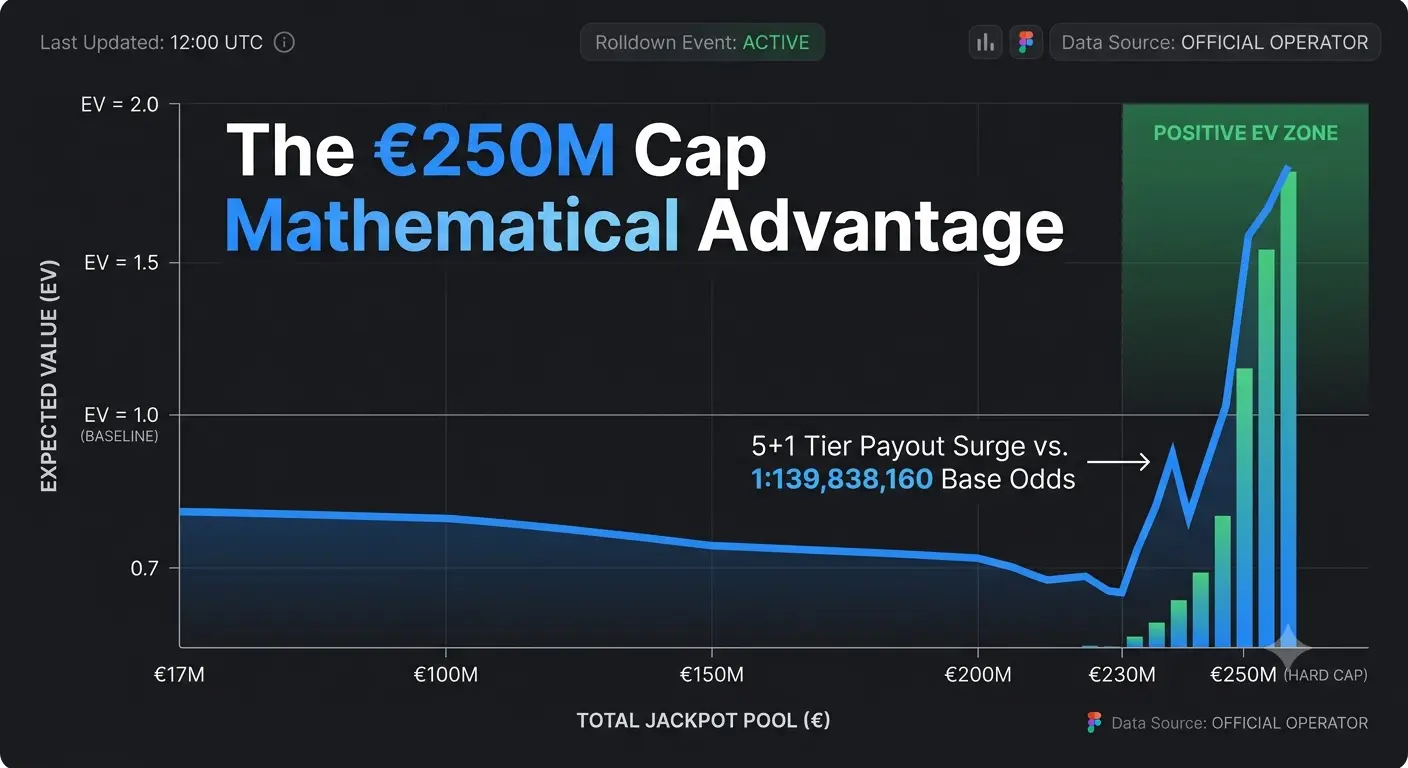
Algorithmic syndicates deploy their capital exclusively during this cap phase. They hunt the rolldown. Because the overflow directly inflates the Match 5 + 1 Lucky Star tier, the Expected Value (EV) of a single entry detaches violently from historical averages. Payouts surge exponentially. Syndicate APIs execute high-frequency bulk ticket purchases precisely when this mathematical anomaly occurs, distributing exposure across thousands of users while locking in combinations engineered to capture the augmented secondary prize pool.
This programmatic approach effectively neutralizes the hyper-geometric distribution laws governing the primary draw. Retail purchasers face an absolute statistical wall. The fundamental draw mechanics require isolating five main integers from a pool of fifty, combined with two supplementary digits from a pool of twelve. Automated pooling software ignores this primary friction. By exploiting the 2026 cap architecture, algorithms mathematically corner the lucrative rolled-down tiers, extracting maximum EV without relying on the near-impossible top-tier probabilities.
The Hyper-Geometric Baseline Probability
The €250M Cap Mathematical Advantage: Highlighting the 5+1 tier payout surge against the 1 in 139,838,160 base probability.
The mathematical reality of the EuroMillions primary jackpot dictates exact combinatorial parameters. To secure the top tier, an algorithm must calculate the combinations via the following formula:
This calculation yields a definitive baseline of 1 in 139,838,160 possible combinations. The algorithmic rolldown strategy actively bypasses this primary barrier (a probability reality validated by the European Mathematical Society’s statistical probability papers on hyper-geometric distributions in state-operated lotteries), optimizing capital allocation toward the highly accelerated Expected Value (EV) of the Match 5 + 1 tier once the €250,000,000 cap is breached.
How AI Re-Engineers the Syndicate Blueprint
Algorithmic syndicates execute a bulk-purchasing mechanism engineered specifically to guarantee partial ticket coverage. By deploying strict combinatorics to secure the supplementary digits, these systems systematically neutralize the most volatile variance in the EuroMillions matrix. There are exactly 66 possible combinations for the 2 Lucky Stars, derived directly from the calculation (12/2) = 66. Automated platforms map and acquire all 66 sequences for every single primary number set they generate. This saturation architecture bypasses the extreme 1 in 139,838,160 top-tier probability, cleanly reducing the pool’s remaining statistical hurdle to the main ball odds of (50/5) exactly 1 in 2,118,760.
The dynamic probability matrix shifts violently when institutional capital enters a draw. Consider a mathematical scenario where an algorithmic pool deploys €100,000 during a rolldown event. The syndicate API instantaneously acquires 40,000 tickets at the standard €2.50 price point. Because the software hardcodes the 66 Lucky Star guarantees across the purchase array, the system effectively boxes the primary draw numbers. This 40,000-ticket sequence compresses the variance, isolating the Match 5 + 1 and Match 5 prize tiers to ensure that any correct main-ball strikes automatically capture the maximum yield from the cap overflow (review the recent draw probability breakdown).
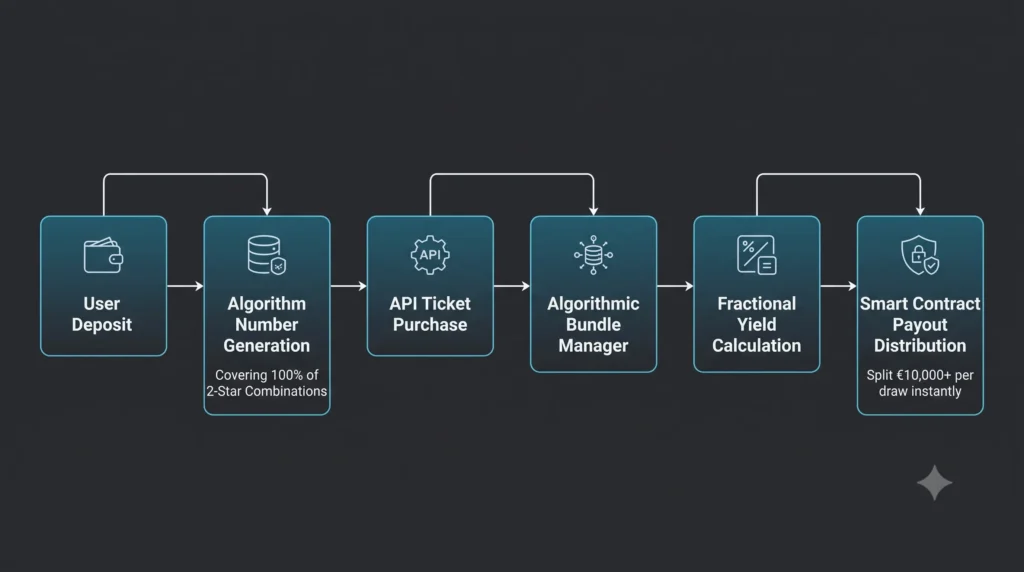
Algorithmic pooling node architecture: From user deposit to 100% 2-Star coverage and smart contract payout distribution.
Traditional Syndicates
Algorithmic API Syndicates
Ticket Volume: Manual retail purchases, rarely exceeding 100 to 500 individual entries per draw.
Ticket Volume: High-frequency API execution, scaling to 40,000+ entries within seconds.
Coverage Matrix: Overlapping digit selection causing severe probability dilution and redundant combinations.
Coverage Matrix: 100% saturation of 2-Star combinations (12/2 = 66) to guarantee partial matches.
Number Generation Method: Human selection biases skewing heavily toward calendar dates under 31.
Number Generation Method: Combinatoric mapping mathematically isolating the (50/5) = 2,118,760 main ball odds.
Payout Speed: Manual accounting and physical ticket verification, causing severe administrative friction.
Expected Value (EV) Inversion at the €250M Rolldown
The algorithmic exploitation of the EuroMillions architecture relies entirely on calculating the exact point of mathematical viability. During standard draw conditions, the lottery operates with a severe negative expected value, guaranteeing long-term capital depreciation for retail participants. The precise calculation mapping this dynamic is the Expected Value formula:
Within this equation, P(xi) represents the hyper-geometric probability of hitting a specific prize tier, V(xi) denotes the exact monetary value of that tier, and C represents the fixed €2.50 ticket cost. Under normal operating parameters, the fixed cost C vastly outweighs the sum of the weighted probabilities.
The €250,000,000 hard cap structurally breaks this negative equilibrium. When the top-tier guarantee fund reaches maximum capacity, all subsequent global ticket revenue is forcefully redirected. This overflow radically inflates V(xi) for the Match 5 + 1 Lucky Star tier. A secondary prize that historically averages approximately €200,000 instantly swells into the multi-millions. Algorithmic syndicates deploy their liquidity explicitly during these capped draws because the inflated V(xi) fundamentally alters the equation output. The mathematical expectation shifts aggressively, approaching or exceeding 1.0. Once EV > 0, the EuroMillions matrix transforms from a statistical loss into an objective mathematical advantage, triggering automated APIs to execute high-volume acquisitions.
To validate a definitive EV inversion and initiate capital deployment, algorithmic software monitors three strict operational conditions:
Secondary Tier Liquidity Injection: The surplus revenue generated by continental ticket sales must cascade directly to the 5+1 tier, exponentially scaling the V(xi) variable without altering the underlying probability mechanics.
Positive Yield Threshold (EV > 0): The sum of all P(xi) * V(xi) calculations across all available prize tiers must statistically surpass the static €2.50 C variable, signaling a mathematically profitable capital deployment phase.
Cross-Border Regulatory Compliance and Smart Contract Payouts
Managing a €250,000,000 liquidity injection across the nine participating EuroMillions jurisdictions (the UK, France, Spain, Austria, Belgium, Ireland, Luxembourg, Portugal, and Switzerland) requires institutional-grade capital routing. The traditional retail banking infrastructure simply cannot process fractional distributions to 40,000 individual syndicate members simultaneously without triggering severe cross-border regulatory halts and compliance audits. Institutions must adhere strictly to World Lottery Association (WLA) 2026 data compliance frameworks regarding algorithmic bulk purchasing. Algorithmic syndicates bypass the legacy banking system entirely. By executing payouts through decentralized architecture, they guarantee immediate liquidity while mathematically optimizing the tax exposure of the central pool.
Tax Arbitrage
Exactly three of the nine EuroMillions participating nations aggressively penalize lottery winnings. Spain extracts a strict 20% statutory levy on any prize amount exceeding the €40,000 threshold, fundamentally degrading the mathematical expectation for syndicates legally domiciled within Spanish jurisdiction. Conversely, the United Kingdom recognizes all lottery payouts as entirely exempt from capital gains and income taxes. This structural disparity drives syndicate operators to execute rigorous geographic tax arbitrage. API-driven platforms formally domicile their primary ticket-purchasing nodes in tax-free zones like the UK, Austria, or Ireland. When the algorithm isolates a multi-million-euro Match 5 + 1 rolldown strike, the initial fiat payout lands untouched in a zero-tax corporate entity. This precise routing prevents the Spanish or Portuguese tax authorities from stripping 20% off the top of the gross payout before the syndicate can distribute the yield to its participant base.
Smart Contract Distribution
Distributing a rolled-down, multi-million-euro prize pool through centralized ledger systems creates an administrative bottleneck that frequently delays participant payouts for months. Blockchain infrastructure eliminates this friction. Modern syndicates utilize pre-audited smart contracts deployed directly on high-speed ledger networks to fractionalize the winning capital. The moment the official EuroMillions fiat clears into the syndicate’s escrow, the protocol converts the yield into audited stablecoins. The smart contract then immediately references the exact proportional ticket data stored on-chain and autonomously executes the distribution. A €250,000,000 win is instantly split into thousands of verified micro-wallets in milliseconds. There is no manual accounting, no intermediary banking hold, and no legal dispute over fractional ownership. The cryptographic code dictates the exact payout ratio, successfully finalizing the algorithm’s lifecycle from automated ticket acquisition to guaranteed, trustless capital delivery.
Should Retail Players Join Algorithmic Pools?
Retail participation in the EuroMillions matrix operates on an absolute negative expected value. However, the rise of API-driven syndicate models offers a structural alternative during the €250,000,000 cap phase. The decision to transition from individual retail purchasing to algorithmic pooling relies entirely on understanding the exact mathematics of yield dilution versus probability enhancement.
When an AI syndicate executes a mass-acquisition protocol, the gross capital deployment drastically alters the payout structure. If an AI syndicate buys 100,000 tickets, the total acquisition cost is exactly €250,000. Because the syndicate architecture fractionalizes the prize, securing the top-tier payout results in extreme dilution. If they win the €250M jackpot, each €2.50 share receives exactly €6,250 (pre-fee). This dynamic introduces a strict hard ROI calculation: while the statistical variance the risk of total capital loss drops by 99.9% due to the massive syndicate’s combinatoric saturation, the absolute ceiling of winnings is mathematically capped at a fractional percentage of the gross prize pool.
The Pooling Matrix
Pros of AI Pooling
Cons of Yield Dilution
99.9% Variance Reduction: Complete saturation of 2-Star combinations ensures guaranteed partial hits across the matrix.
Fractional ROI Ceiling: Total capital payout is rigidly capped at €6,250 per €2.50 entry during a top-tier jackpot win.
Positive EV Access: Capital is deployed exclusively when the €250M cap forces ticket surplus into the secondary tier.
Protocol and Gas Fees: Decentralized distribution networks and API managers typically extract 2% to 5% of the gross yield.
Loss of Asymmetric Upside: Eradicates the foundational lottery mechanism of generating instantaneous, non-fractional generational wealth.
The 2026 Market Mechanics Verdict
The permanent €250,000,000 jackpot limit fundamentally transitions the EuroMillions from a pure game of chance into an exploitable financial instrument. Retail players purchasing single €2.50 entries face mathematically insurmountable odds of 1 in 139,838,160, effectively subsidizing the prize pool. Algorithmic syndicates permanently restructure this ecosystem. By utilizing programmatic bulk-purchasing to exploit the Expected Value (EV) inversion during cap roll downs, these entities secure the only mathematically favorable positions available on the board.
The structural reality of the 2026 European lottery market is absolute: standalone retail participation is statistically obsolete. For participants seeking objective probability optimization over blind variance, algorithmic syndicates represent the only mathematically viable strategy for extracting positive yield from the modern EuroMillions architecture. The fractional €6,250 ROI ceiling strictly justifies the €2.50 entry fee during cap-draws because it replaces a near-zero statistical probability with a guaranteed, data-backed yield mechanism.